“Deploy the agent. Automate the process. Free your people for higher-value work.”
Familiar pitch, right? That pitch is everywhere right now, and it sounds like an amazing promise. But it always stops before the inconvenient part: where the agent hits its ceiling, and why that ceiling has nothing to do with which platform you chose.
This article is the honest map most vendor conversations skip. The insights draw on our own customer work across industries and on a recent conversation with Boris Krumrey, who was solving the human-to-human version of the knowledge transfer problem long before LLMs existed. Now he is applying the same methods to human-to-agent handoffs, and the parallels are eye-opening.
The quotes throughout this article come from a conversation I had with Boris in London. You can watch the full interview here.
First, let’s agree on what we’re actually talking about
Before any serious conversation about enterprise agents can happen, one definitional problem needs to be resolved: most of what is currently being sold as “agentic AI” is not actually agentic.
“People think storing a prompt and combining it with a RAG is an agent. It isn’t. An agent needs to reflect, plan, use tools, collaborate with other agents, and have memory. Everything else is just a very fancy chatbot.“ — Boris Krumrey
That distinction is not semantic. It has direct implications for what you are buying, what you are building, and what level of governance each type of system requires.
A real agent, by the definition that holds up technically and practically, does these 5 things:
- Reflects on its own outputs to catch errors and reduce hallucinations;
- Plans sequences of steps rather than responding to single prompts;
- Uses tools to take actions across systems;
- Collaborates with other agents to complete complex tasks;
- Retains memory to ground its responses in relevant, persistent context.
A system that does one or two of these things is useful, but it is not an agent.
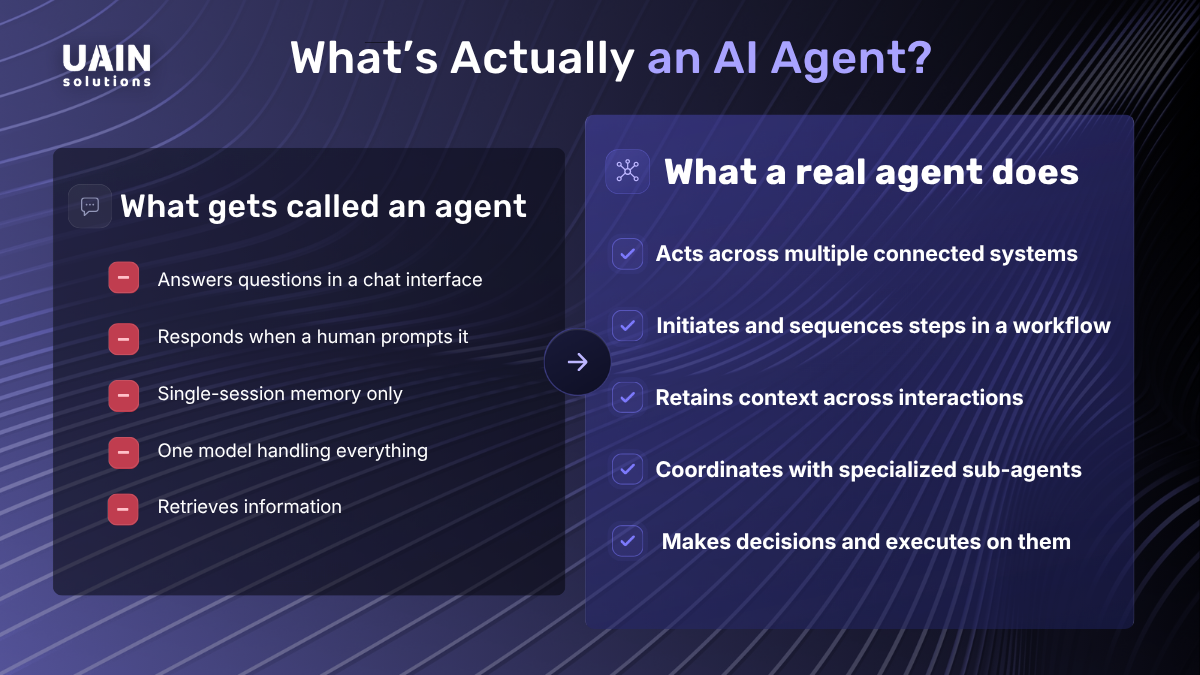
Every major software vendor is currently pitching agents. This table is a starting checklist for evaluating those pitches. If the system on the slide cannot do the things in the right column, the conversation about governance, accuracy, and ROI is happening at the wrong level of ambition, or the wrong level of risk.
What real agents actually do (the unglamorous version)
The best enterprise agent deployments right now are unglamorous, specific, and immediately profitable. Boris’s favorite example involves a cheese producer. The company had a standing problem with retailer claims: whenever a delivery fell short of contracted volumes, retailers would submit claims for refunds. The retailers, value-driven businesses themselves, had automated this process with RPA, meaning claims arrived fast, at volume, regardless of whether they were contractually justified. The cheese maker was consistently paying out more than it owed, because validating each claim manually against contract terms, service level agreements, and delivery communications was too slow and too expensive to do at scale.
A single agent built with UiPath was able to solve it. The agent read the contracts, checked the service level obligations, reviewed the relevant email threads, and made a determination on each claim: valid or not.
“That agent was looking at all the emails, validating against contracts, checking service levels, and saying: ‘Nope, not this one.’ It immediately saved them a lot of money.“ — Boris Krumrey
This is representative of where agentic AI delivers fastest in enterprise settings. It doesn’t replace humans wholesale, but processes high-volume decisions with contractual or regulatory logic that is well-documented but too complex and numerous for manual handling at scale. Claims management, procurement validation, compliance checking, Accounts Payable/Receivable dispute resolution: every large organization has a version of this problem.
From this example, it’s worth taking this design principle: the goal is not to replicate the existing process with AI in place of humans, but to remove friction and redesign the work around what the technology actually does well. Optimization versus replication — that distinction separates the deployments that deliver ROI from the ones that just shift the bottleneck.
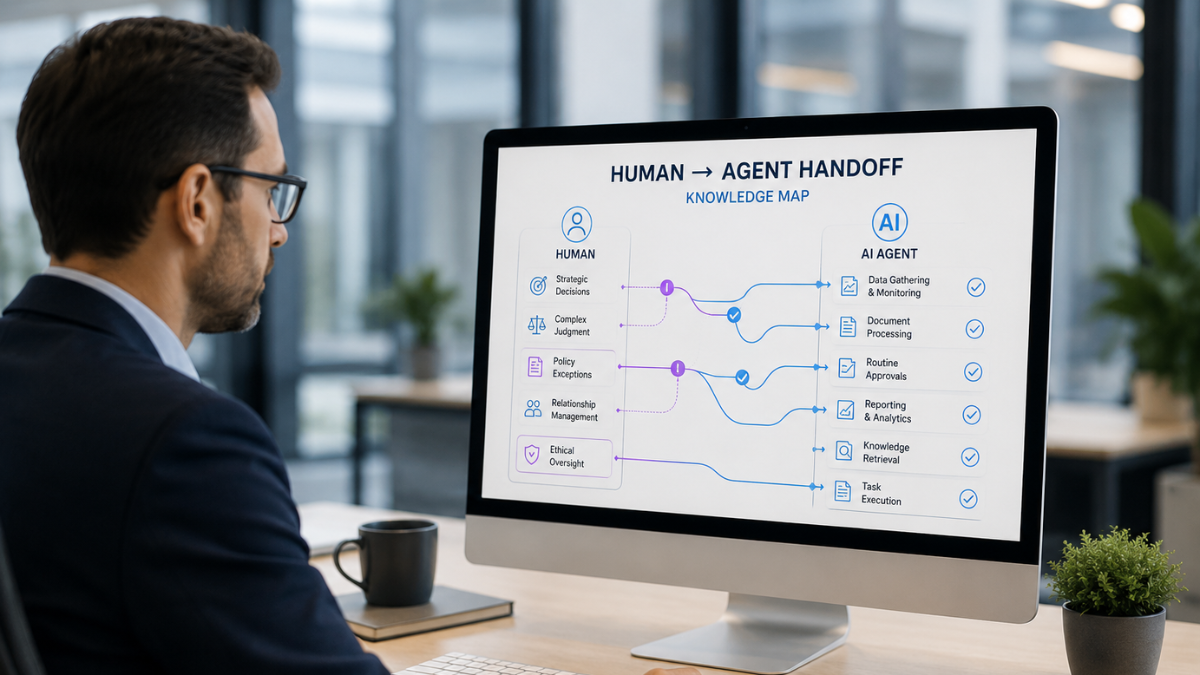
The knowledge map: where agents win and where humans stay essential
According to Boris, most vendor pitches avoid a simple truth:
“There is a structural ceiling on what agents can do, it sits at roughly 80 to 85 percent accuracy for most knowledge-intensive tasks, and understanding why it exists is the most important design input for any serious agentic program” — Boris Krumrey
And we cannot agree more.
The three types of knowledge that determine what agents can (and can’t) do
1. Explicit knowledge
Type that is documented: processes, contracts, SOPs, decision trees, policy manuals. It is imperfect and often out of date, but it exists in a form that can be ingested, structured, and acted on. Agents handle explicit knowledge well, and this is where early agentic wins concentrate, rightly so.
2. Implicit knowledge
It is the judgment a senior clinician applies when interpreting ambiguous test results. Or it can be the learning a veteran procurement officer has on a supplier relationship that has never been written down. Even the instinct a lawyer develops after years of seeing how courts actually interpret contract language versus how it reads on paper.
“You can get an agent to 80 to 85% accuracy. But that last stretch requires the implicit knowledge of a clinician, a lawyer, someone who’s done the job for years. That’s not in any document.” — Boris Krumrey
3. Relational knowledge (coming from relationships between people)
Which deadlines actually move, which stakeholders will flex if you ask the right way, and which agreements have always had more give than the contract suggests. People learn this through relationships built over years. It travels through trust, not documentation, and that is precisely why it remains out of reach for agents, at least for now.
This is not a technology limitation that the next model release will solve. It is a structural feature of how human expertise works, and enterprises that scope their agentic programs without accounting for it will either over-promise on automation or under-invest in the human-in-the-loop design.
The more actionable question is what happens in the middle, with knowledge that is not fully documented but is not entirely inaccessible either. This is where Boris’s methodology becomes most valuable. Working with subject matter experts to transfer their tacit knowledge into a form agents can use is a discipline, not an accident. It requires structured templates that force experts to organize what they know into categories with clear decision logic, and it does not work with unstructured brain dumps.
“The experts would dump everything, totally convoluted, unstructured, and say ‘it’s all there, help yourself.’ That doesn’t work. We created templates that force people to structure that knowledge so it becomes something an agent can actually act on.” — Boris Krumrey
Before scoping any agentic investment, map your target process against these three types of knowledge. Explicit knowledge processes are fast to automate, carry manageable risk, and generate real proof points. Implicit knowledge processes need human-in-the-loop design from the start, not as an afterthought when accuracy falls short. Relational knowledge, the kind that lives in trust, tenure, and unwritten understanding between people, is out of reach for agents for now, and any process that depends on it should be scoped accordingly. The middle ground between explicit and implicit is accessible, but only with the right knowledge transfer methodology, and only if the right people get asked the right questions.
The governance problem, named and solved
Shadow IT was manageable because software had version numbers, license agreements, and audit trails. Agent sprawl is structurally different and operationally harder to contain.
Agents are being built bottom-up, by individuals, using natural language. They embed institutional knowledge about processes, about systems, about how decisions actually get made, not to mention sensitive business data. They touch live systems and take real actions. When the person who built them changes roles or leaves the organization, what they built does not leave with them in any visible way. It stays running, or it stays dormant, and in either case nobody knows it is there.
“I already had a customer who said: ‘What do we do with all these agent zombies people have created with Copilot? We don’t even know where they are.’ If someone leaves the company, do they take their agent skills with them? It’s company property and nobody knows about it.” — Boris Krumrey
This is not a future risk to monitor. It is a present condition in most organizations that moved quickly on AI tool access without a corresponding governance framework. The remediation is not complicated, but it needs to happen before the next wave of deployment adds more volume to an already uncharted inventory.
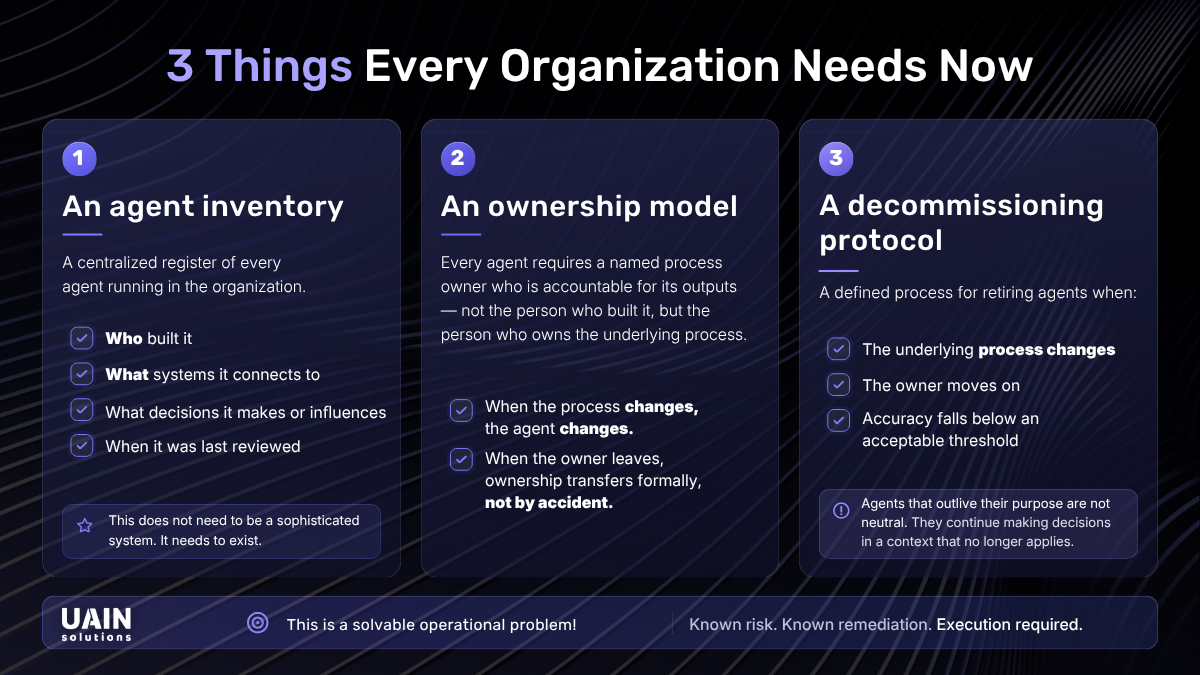
Three things every organization needs now
An agent inventory
A centralized register of every agent running in the organization: who built it, what systems it connects to, what decisions it makes or influences, and when it was last reviewed. This does not need to be a sophisticated system. It just needs to exist.
An ownership model
Every agent requires a named process owner who is accountable for its outputs, not the person who built it but the person who owns the underlying process. When that process changes, the agent changes. When that owner leaves, ownership transfers formally, not by accident.
A decommissioning protocol
A defined process for retiring agents when the underlying process changes, the owner moves on, or accuracy falls below an acceptable threshold. Agents that outlive their purpose are not neutral. They are actively making decisions in a context that no longer applies.
This is a solvable operational problem, sitting in the same category as any other process governance gap: known risk, known remediation, execution required.
The workforce equation: a permanent divergence, not a training problem
The talent conversation around AI in most enterprises is framed as a change management challenge: how do we bring people along, reduce anxiety, and build capability across the organization? That framing is not wrong, but it is incomplete, and the part it misses is more strategically important than the part it addresses.
“There are two types of people: those who use LLMs to learn everything, and those who use them to avoid learning anything. The first group will master this change. The second will really struggle.” — Boris Krumrey
This is not a training problem. It is a disposition problem, and no mandatory AI literacy program will close the gap between someone who is genuinely curious about what these tools can do and someone who is using them to offload thinking they no longer want to do. The first group is compounding expertise at an accelerating rate. The second is quietly hollowing out theirs. Both outcomes are already in motion.
The strategic implication for enterprise leaders is less about identifying which employees to develop and more about recognizing which type of expertise the transformation itself actually requires.
For years, the discipline of enterprise outsourcing was about moving work to where equivalent skills were available at lower cost. The methodology that made this work was service transition:
→ Scoping operations
→ Defining measurable outcomes
→ Mapping the knowledge
→ Transferring that knowledge between human teams
→ Governing the handoff to full team ownership.
Now, we’re moving from human-to-human knowledge transfer to human-to-agent knowledge transfer. The steps are the same, and what changes is the recipient.
The implication for enterprise leaders is concrete and immediately actionable. The most valuable expertise for agentic transformation programs is not primarily technical. It is operational and methodological: the ability to scope services, map knowledge, design handoffs, and govern outcomes. That expertise may already exist in the organization, sitting in a function labeled change management, outsourcing governance, or service delivery. The question is whether it is being applied to the right problem.
Three questions to take into your next leadership meeting
The organizations that will navigate this well are not necessarily the ones with the most advanced tools or the largest AI budgets. They are the ones that are honest about where they actually stand, and rigorous about what the work of transformation requires.
Three questions worth putting on the table before the next strategic conversation about agents:
Do you know how many agents are running in your organization right now? If the answer is no, or uncertain, that is the first problem to solve, not the next deployment decision.
Can you confirm that explicit knowledge is enough to reach automation KPIs for your top automation candidates? If you cannot, the project may not be ready to scope. Make sure to discuss this with your implementation partner.
Do you have a change management lead on your agentic program, or just an AI engineer? The technical build is rarely where enterprise transformations fail. The knowledge transfer design, the human-in-the-loop architecture, the governance model — that is where they succeed or fall apart.
The organizations that move fastest will not be the ones with the most sophisticated AI stack. They will be the ones that recognize the work of transformation for what it actually is, and bring the right expertise to it from the start.